
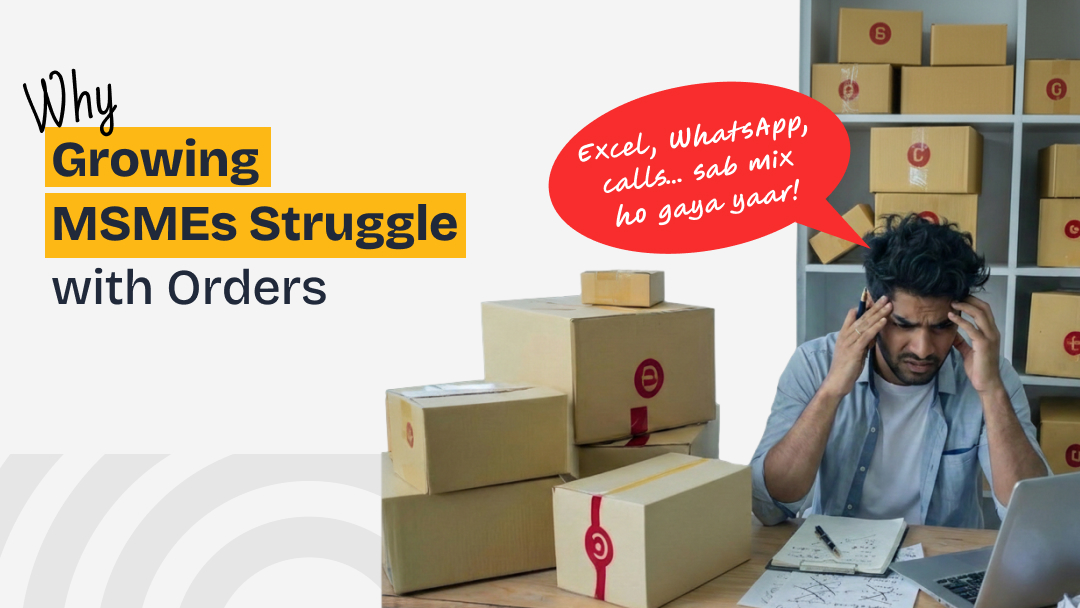
Why Growing MSMEs Struggle With Orders Even When Sales Are Strong
And How Structured Order Booking Creates Operational Stability
There is a particular kind of operational problem that tends to surface not when a business is failing, but when it is doing well. Sales are increasing. New customers are coming in. Order volumes are climbing. And yet, somewhere in the middle of all that apparent progress, the day-to-day has started to feel unstable. Decisions are slower. Mistakes are more frequent. The founding team is stretched thin, and nobody quite has a clean answer for where any given order stands at any given moment.
This pattern shows up consistently in growing Indian MSMEs, and it deserves a more careful examination than it usually receives. The instinct is to assume that operational friction comes from weak sales or poor team discipline. In practice, the more common scenario is the reverse: strain intensifies precisely because order volumes are rising faster than the underlying system can manage them.
What follows is an attempt to diagnose why this happens, and what it actually takes to build an operational base that holds up as order booking increases.
The Structural Gap That Order Management Software Is Built to Close
To understand where the problem originates, it helps to map out how a typical order actually moves through a growing MSME.
- A typical order, traced from start to finish, moves something like this:
- A lead arrives through IndiaMART, a referral, or a direct call
- The customer places an order over the phone or through WhatsApp
- Someone consolidates the details manually, calculates the customer-specific price, and sends a quote
- The customer approves, the order is confirmed
- Stock availability is checked separately, usually by calling the warehouse or opening a spreadsheet
- If inventory is short, production or procurement is informed, often through another message or call. Dispatch is looped in, updates are relayed back to the customer through the same informal channels
- The delivery happens, and the accounting entry is recorded later, in a separate system, by a different person
Each of these steps is handled by people. Each requires coordination. And at no point in this process is there a single place where all of the relevant information sits together, visible to everyone who needs it.
This is the structural gap. It is not created by carelessness or lack of effort. It is created by the absence of an order management software layer that connects order booking to operational execution. Accounting systems record what happened. They do not manage the process through which orders are booked, confirmed, modified, and fulfilled. That part, in most MSMEs, is still held together by memory, messages, and manual coordination.
The gap is manageable at a small scale. At ten or fifteen customers, a founder can carry most of the relevant information in their head. But at sixty or eighty customers, with different pricing for each, frequent rate changes, and multiple delivery timelines running simultaneously, the informal approach reaches its limit.
Why the Gap Becomes Risky at Scale
Pricing complexity is where B2B order management software earns its place.
Indian B2B trade runs on negotiated pricing. Different customers receive different rates, based on order volume, payment terms, the history of the relationship, and sometimes factors as informal as a conversation from three months ago. A growing MSME may be managing fifteen or twenty distinct customer-specific price points, alongside bulk pricing tiers, advance payment discounts, and temporary rate adjustments during supply fluctuations.
When this complexity is tracked manually, whether in spreadsheets, notebooks, or the salesperson’s memory, errors become inevitable. A price that was updated for one customer gets applied to another. A discount that was agreed upon verbally does not make it into the invoice. A rate that changed last week is still being quoted from an older list. The result is not just financial loss, though that is real. It is the erosion of the trust that makes B2B relationships work in the first place.
B2B order management software exists, in part, to remove this risk. When pricing logic is built into the order booking system, customer-specific rates apply automatically. The chance of a manual calculation error, or a misremembered agreement, drops significantly.
Inventory commitments need inventory and order management software behind them
When a customer calls and asks whether you can deliver 500 units by Thursday, the honest answer often requires checking. But in a busy operation, checks take time, and customers expect quick responses. The temptation is to say yes based on a rough sense of what is in stock, and then figure out the details later.
This works until it does not. When order booking and inventory visibility are not connected, overselling becomes a recurring problem. Orders get confirmed against stock that has already been allocated elsewhere, or stock that simply does not exist. Fulfillment then becomes reactive, scrambling to source from alternate suppliers at higher cost, or managing the awkward conversation with the customer about a delayed delivery.
Inventory and order management software addresses this by making stock levels visible at the moment of order confirmation. Before a commitment is made, the system reflects actual availability. This does not eliminate supply complexity, but it removes one of the most common sources of unnecessary firefighting.
Fulfillment planning improves when an order management platform structures the queue
When there is no centralized view of what orders are coming in and when they need to be dispatched, fulfillment planning defaults to urgency. The loudest customer, or the most recent call, gets attention first. Orders that were placed earlier, by customers who are not following up as aggressively, risk being deprioritized without anyone intending that to happen.
An order management platform creates a structured queue. Orders are visible in sequence, with confirmation dates, expected delivery timelines, and current status. Dispatch planning shifts from reactive to anticipatory. The team knows what is coming before it becomes urgent, and can plan capacity accordingly.
Accounting records transactions but does not ensure operational alignment
This distinction deserves particular emphasis, because it is frequently misunderstood.
Accounting software does what it is designed to do: it records financial transactions. Sales, purchases, credit, debit, billing, invoices. It does this well. The problem is that it begins at the end of the operational process, not at the beginning. By the time an entry is made in an accounting system, the order has already been placed, confirmed, modified, potentially disputed, and fulfilled. The accounting system records the outcome. It does not manage the sequence of events that produced that outcome.
What growing MSMEs need is not better accounting, at least not primarily. They need a system that manages the operational lifecycle of an order from the moment it is booked to the moment it is delivered, with accounting system integration that allows financial records to reflect validated operational data without requiring duplicate entry.
When order management and accounting operate as separate, disconnected processes, someone has to manually reconcile them. That reconciliation work is invisible from the outside, but it consumes significant time and introduces its own category of errors.
Why More Coordination Is Not a Substitute for Order Management Automation
The first response most businesses have when operational friction starts to build is to increase coordination. More calls between departments. A shared WhatsApp group for order updates. A weekly meeting to go over pending deliveries. An Excel sheet that everyone is supposed to update.
These efforts come from a genuine place. They are attempts to address a real problem. But they tend to treat the symptom rather than the cause. The underlying issue is not that people are failing to communicate. It is that the information itself lives in too many separate places, and communication is the only mechanism available to reconcile it.
Adding more communication on top of a fragmented system increases the coordination load without reducing the ambiguity. The WhatsApp group fills up with messages. The shared spreadsheet has version conflicts. The meeting surfaces problems that have already been festering for days. And the founder, or whoever is at the center of the coordination effort, becomes increasingly stretched.
Order management automation is sometimes framed as a way to speed things up. That is a partial description at best. The more accurate framing is that it replaces coordination overhead with system-level clarity. When an order is entered once and becomes immediately visible to sales, operations, and accounts, the need for manual coordination does not just decrease. In many cases, it disappears entirely.
Automated order processing software does not speed up a broken process; it replaces the process with something that does not require people to serve as connective tissue between departments.
What the Best Order Management System Actually Changes in Practice
The shift that comes with a properly structured order management platform is less dramatic than it might sound, but the cumulative effect is significant. In practical terms, here is what changes:
Order sent once
A customer places an order, and the record is immediately visible to the full team with complete details: what was ordered, quantity, agreed price, and expected delivery date. No relaying, no duplicate entry, no version conflicts.
Pricing applies automatically
Customer-specific rates, bulk tiers, advance payment discounts, seasonal adjustments, all embedded in the system and applied at the moment of booking. Manual calculation errors drop to near zero.
Inventory is visible before committing
Before an order is confirmed, the system reflects current stock levels. If availability is tight, the supplier knows before making a promise they cannot keep.
Status updates flow through the system
When an order moves from confirmed to processing to dispatched, the customer can see that progression without calling to ask. Follow-up calls decrease without anyone having to manage that reduction deliberately.
Accounting entries reflect validated operational data
The order management tool and the accounting system work together, so financial records reflect confirmed reality rather than a reconstruction of what probably happened.
This is what the best order management system actually delivers in practice. Not a dashboard of metrics nobody reads. A connected operational flow where the right information reaches the right people at the right time, without requiring a founder or manager to serve as the conduit.
A Strong Case on Where Manual Systems Stop Working
It would be uncharitable and inaccurate to say that spreadsheets or accounting platforms are inadequate tools. They are not. They perform their intended functions well, within the conditions for which they were designed.
Spreadsheets work when the information they contain is updated by one person, used by one person, and reviewed infrequently enough that version conflicts do not accumulate. Accounting systems work when the operational data they are recording is already clean, already validated, and consistent. The difficulty is that, as order volumes grow and customer-specific pricing proliferates, neither condition holds.
A spreadsheet being edited by four people simultaneously, tracking eighty customers with different pricing rules and daily rate changes, is not a spreadsheet doing its job well. It is a spreadsheet being asked to do a job it was not built for. The same applies to an accounting system being asked to serve as the primary record of order commitments, delivery timelines, and fulfillment status.
All-in-one business management software attempts to consolidate these functions within a single environment. The caution worth noting is that consolidation for its own sake does not resolve the structural problem. What matters is whether the core operational workflow, order booking, pricing application, inventory confirmation, fulfillment tracking, and accounting integration, is genuinely connected rather than a collection of separate tools forced into the same interface.
How to Evaluate an Order Management System for MSME Reality
For MSMEs evaluating order management software, the relevant questions are practical rather than theoretical. Questions to ask yourself before investing in one:
- Does it handle customer-specific pricing without manual override at every order? This is not an edge case in Indian B2B trade. It is the standard, and any system that treats negotiated pricing as an exception is not built for this market.
- Does order booking connect directly to inventory visibility? If a separate manual step is needed to check stock before confirming, the structural gap has not been closed; it has merely moved.
- Can the full order lifecycle, from placement to delivery, be tracked within one environment? If fulfillment status lives in a different tool from order confirmation, the coordination problem persists.
- Does accounting system integration work without duplicate data entry? If reconciling operational and financial records requires someone to re-enter data from one system into another, time is being wasted and errors are being introduced.
- Can the team use it without extended training or dedicated IT support? For most MSMEs, this is not a minor consideration.
Where and Why Biizline Fits Within This Framework
Biizline is a private, shared B2B order management environment used jointly by suppliers and their customers. Not an ERP, not a marketplace, not an accounting platform. It is built specifically for how Indian MSMEs actually operate: relationship-driven, with negotiated pricing, informal communication, and variable order volumes.
The system formalizes what emerges from those relationships without disrupting them. When a customer places an order, both parties see the same record. Pricing is locked in at that moment. Inventory levels are reflected. Status is visible as the order moves forward. And when it is time to invoice, the operational data is already clean, with no manual reconciliation needed.
- Customer-specific pricing, bulk tiers, and advance payment discounts are applied automatically at order booking
- Real-time stock visibility before commitments are made
- Order status tracking is visible to both the supplier and the buyer, without follow-up calls
- A private workspace, not a marketplace, so pricing and customer relationships stay between the two parties
- Accounting system integration, so confirmed operational data feeds into financial records without duplicate entry
See how other MSME owners use it →
Operational Alignment as a Condition for Sustainable Growth
Growing MSMEs do not struggle because of weak sales or poor intent. They struggle because order booking, fulfillment, and financial records operate as three separate processes held together by people rather than a system.
Accounting software records what happened. Spreadsheets track what someone wrote down. Neither manages the operational lifecycle of an order. That is a different function, and it requires a different kind of tool.
When that function is covered, the day-to-day becomes quieter. Fewer follow-ups, fewer pricing disputes, and less time spent reconstructing what was agreed. This allows you, as a founder, to spend less time on firefighting and focus more on strategy and growth.
Growth requires structure at some point. Not for its own sake, but because without it, the cost of managing orders eventually absorbs the margin that growth was supposed to create.